Vegetable soybean (edamame) is a popular legume vegetable valued for its sweet flavor and rich nutrients. Unlike most harvested vegetables, however, its pods do not simply decay after harvest. They keep developing from the green full-seed stage toward full maturity, a process known as “rounding-off”, which causes rapid water loss and quality deterioration. Low-temperature storage is currently the main way to extend shelf life, but whether pre-harvest field management can improve storability remains poorly understood.
Recently, a research team led by Prof. ZHANG Qiuying from the Key Laboratory of Soybean Molecular Design Breeding, Northeast Institute of Geography and Agroecology, Chinese Academy of Sciences (CAS), found that combining pre-harvest potassium (K) fertilization with postharvest cold storage markedly extends the shelf life of vegetable soybean. After nine days of storage, pods from K-fertilized plants kept at 4 °C lost only 11.3% of their fresh weight. In contrast, pods from K-deficient plants stored at 25 °C lost 66.5%.
The study was published in Food Research International on Aug. 30, 2026. Dr. LIU Changkai is the first author, and Assoc. Prof. LI Yansheng is the corresponding author.
The researchers grew the vegetable soybean cultivar “Zhongkemaodou 3” under K-deficient and K-sufficient conditions, and stored the harvested pods at 4 °C or 25 °C. They combined physiological assays, widely targeted metabolomics and transcriptomics to track postharvest quality changes. They then validated the role of jasmonate (JA) signaling by treating pods with exogenous methyl jasmonate (MeJA) in a field experiment.
The results showed that adequate K nutrition raised seed K content from 12.0 to 15.0 mg g⁻¹ and maintained low basal lipoxygenase (LOX) activity at harvest. This suppressed the oxidation of membrane polyunsaturated fatty acids (PUFAs). Notably, α-linolenic acid is both a substrate for membrane lipid peroxidation and a biosynthetic precursor of JA. Protecting it from oxidation therefore also weakened JA-driven senescence signaling.
Metabolomic analysis further revealed co-enrichment of flavonoid and phenylpropanoid pathways, suggesting that antioxidant defense and JA-driven senescence are co-regulated during storage. The MeJA experiment confirmed the promotive role of JA signaling. Exogenous MeJA increased endogenous JA in a dose-dependent manner, activated JA biosynthetic genes such as GmLOX2, AOS and AOC, and accelerated pod dehydration and senescence through crosstalk with ethylene and abscisic acid pathways.
Based on these findings, the researchers proposed a “membrane lipid–oxylipin–hormone” regulatory axis linking pre-harvest K nutrition to postharvest senescence. The study suggests that integrating pre-harvest K management with postharvest cold-chain logistics offers a practical “from field to table” strategy to reduce postharvest losses of vegetable soybean.
According to the researchers, the role of K is currently inferred from correlative physiological and omics evidence. Direct functional tests, such as postharvest K supplementation or manipulation of K transport, are needed to establish causality. Future work will also verify the causal roles of the antioxidant metabolites identified in this study.
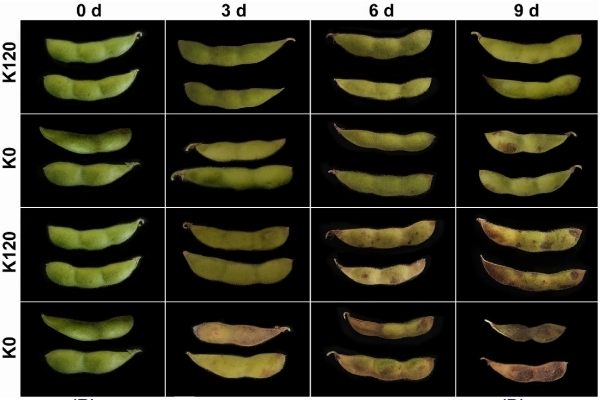
Figure 1. Appearance changes of vegetable soybean pods under different potassium and temperature treatments during nine days of storage.
(Image by LIU Changkai)
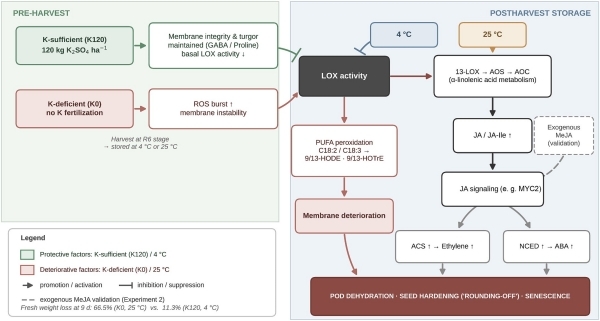
Figure 2. A working model linking pre-harvest potassium nutrition and postharvest storage temperature to pod senescence via the “membrane lipid–oxylipin–hormone” axis.
(Image by LIU Changkai)
Contact:
Yansheng Li
Key Laboratory of Soybean Molecular Design Breeding, Northeast Institute of Geography and Agroecology, Chinese Academy of Sciences
E-mail: liyansheng@iga.ac.cn
https://doi.org/10.1016/j.foodres.2026.120571.


