The early development of rice seeds is a critical phase for embryo morphogenesis, endosperm differentiation, and subsequent grain formation. At 3–7 days after pollination (DAP), the embryo gradually establishes its basic tissue morphology, while the endosperm undergoes cellularization and further differentiates into distinct functional regions. However, due to the small size, complex tissue architecture, and diverse cell types of early seeds, the molecular characteristics of different cell populations and their developmental relationships remain poorly understood. In recent years, the development of single-cell and single-nucleus transcriptome sequencing technologies has provided new approaches for dissecting early rice seed development at the cell level.
Recently, a research team led by Prof. BU Qingyun from the Northeast Institute of Geography and Agroecology, Chinese Academy of Sciences (CAS) constructed a high-resolution single-nucleus atlas of early rice seed development.
This work was published in Journal of Integrative Plant Biology on Aug. 17.
This study present a single-cell atlas of developing rice seeds based on single-nucleus RNA sequencing from rice caryopses. Integration with bulk RNA-seq, in situ hybridization, and promoter-GUS staining annotated cell type systematically. Ultimately, cell populations corresponding to starchy endosperm, aleurone layer, ventral aleurone layer, embryo-endosperm interface, early embryo, embryonic axis, scutellum, pericarp, and nucellus were identified, and a set of cell-type-specific marker genes was obtained, providing an important basis for future in-depth functional analyses. Further, integration and analysis of single-nucleus transcriptomic data from rice pistils and early seeds revealed that some maternally derived cells exhibited clear transcriptional level correlation. Meanwhile, some nucellus cells were found to be enriched in genes associated with programmed cell death and transport, suggesting that dynamic changes in maternal tissues may be involved in the regulation of material transport and nutrient supply during seed development. Additionally, using high-dimensional weighted gene co-expression network analysis (hdWGCNA), significant associations were identified between certain gene co-expression modules and specific cell types. For instance, the starchy endosperm-associated module was enriched in known regulators of endosperm development, including OsbZIP58, OsNF-YA8, and OsPUL3, which further corroborated the reliability of the single-nucleus transcriptomic atlas and cell-type annotation. Moreover, genetic analysis revealed that loss-of-function mutants of the FIB gene, located in an embryonic axis-related module, displayed aberrant grain filling and embryonic defects, suggesting that this atlas has the capacity to uncover critical regulatory factors in seed development.
Notably, the research revealed a distinct population of embryo-endosperm interface (EEI) cells positioned at the boundary between the developing embryo and endosperm. These EEI cells were specifically enriched in transport-related and developmental regulatory genes with known functions in seed development and embryogenesis. Loss of function of the EEI-enriched regulator OsBZR4 altered the cellular composition and transcriptional programs of early developing seeds, disrupted embryonic developmental progression, and reduced the expression of embryonic genes, including OsCDP3.10 and RINO1.
In this study, a high-resolution single-nucleus transcriptomic atlas of early development rice seed was constructed, the molecular characteristics of embryo, endosperm, and maternally derived cell populations were systematically resolved, and a comprehensive set of cell-type-specific marker genes was established. Notably, the identification of the embryo–endosperm interface (EEI) cell population and its regulatory features offers new insights into the coordinated development between the embryo and endosperm. Altogether, this work not only deepens our understanding of cellular diversity and developmental processes in rice seeds, but also serves as a valuable resource for elucidating the mechanisms of seed formation and for improving key agronomic traits.
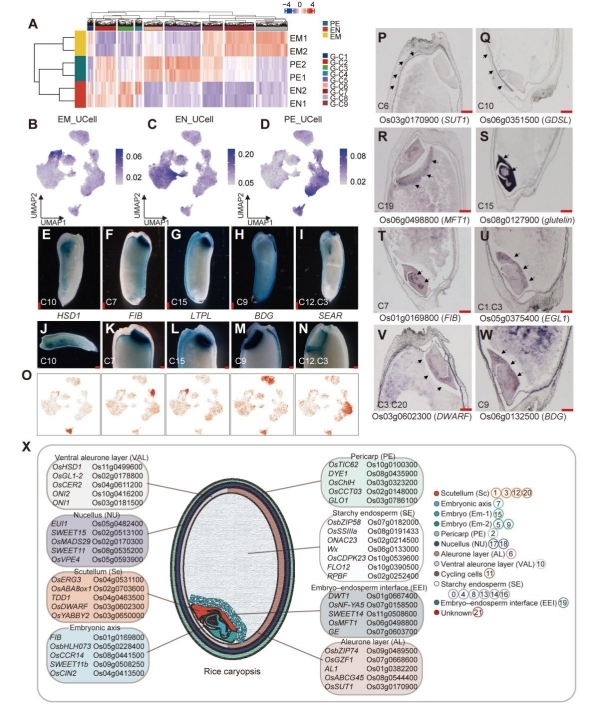
(Image by WANG Zhenyu)
Contact:
Zhenyu Wang
Northeast Institute of Geography and Agroecology, Chinese Academy of Sciences
E-mail: wangzhenyu@iga.ac.cn


