Drought stress poses a huge challenge to plant productivity and food security worldwide. Plants have evolved complex mechanisms to optimize growth under drought conditions, and accumulating evidence indicates that the rhizosphere microbiome, recruited by plant-secreted root exudates also plays a crucial role in host drought stress adaptation. Despite extensive research on interactions between plant hormone and rhizosphere microbiome, the mechanistic interactions between individual rhizosphere microbes and plant signaling pathways, such as the potential role of microbial metabolites as hormone receptor antagonists, are still largely unexplored.
To explore how rhizosphere microbes activate plant hormone signaling pathways to regulate plant drought tolerance, a new study using Arabidopsis thaliana as a model plant, elucidates a novel mechanism by which the key rhizosphere bacterium Rhodanobacter boosts plant drought tolerance by secreting daidzin to activate the karrikin (KAI2) signaling pathway.
The study, led by scientists at the Northeast Institute of Geography and Agroecology (IGA) of the Chinese Academy of Sciences (CAS), was published in Science Advances on July 1.
Previous studies by the team have demonstrated that the karrikin receptor KAI2 protein positively regulates drought tolerance in Arabidopsis thaliana. However, it remains unclear whether this KAI2-mediated positive regulation of plant drought tolerance relies on soil microbiome. In the study, the team demonstrated that KAI2-mediated drought tolerance in Arabidopsis was dependent on the rhizosphere microbiome using wild-type (WT) and kai2 mutant. Further investigations revealed that under drought conditions, the roots of WT and kai2 mutant selectively recruit Streptomyces and Rhodanobacter, respectively. And Rhodanobacter regulates drought tolerance in Arabidopsis in a KAI2-dependent manner.
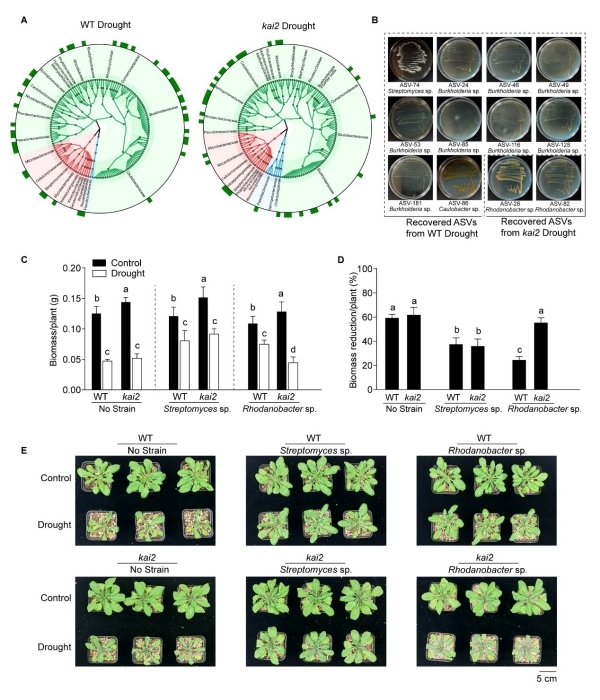
Rhodanobacter regulates drought tolerance in Arabidopsis in a KAI2-dependent manner
Combining multi-omics techniques including transcriptomics and metabolomics, molecular docking analysis, as well as a series of molecular and biochemical assays, the team systematically elucidates the KAI2-dependent drought tolerance promotion triggered by Rhodanobacter. The results showed that Rhodanobacter secretes daidzin, a key flavonoid compound. Daidzin directly binds to KAI2 and activates downstream signaling cascades, thereby upregulating the expression of multiple drought-resistant genes and enhancing plant drought tolerance.
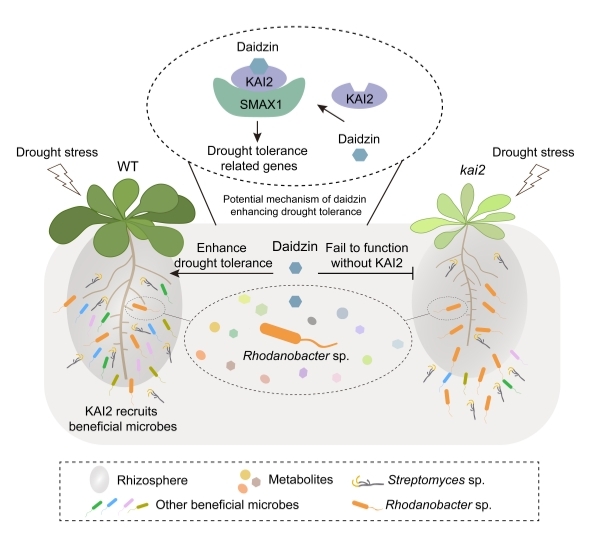
Proposed model for involvement of Rhodanobacter in KAI2-mediateddrought tolerance in Arabidopsis
This study unravels a novel mechanism by which rhizosphere key microbes activate karrikin signaling pathways via secreted metabolites. These findings deepen the understanding of plant-microbe interactions and provide crucial theoretical support for improving plant stress resistance through microbial biotechnology.
SUN Yu, an associate professor from the IGA, is the first author of the paper. Professor Lam-Son Phan TRAN from the Texas Tech University, TIAN Chunjie, LI Weiqiang, and YIN Xiaojian from the IGA, are the corresponding authors.
This work was supported by the National Natural Science Foundation of China, the Strategic Priority Research Program of CAS, and the Young Scientist Group Project of Northeast Institute of Geography and Agroecology.
Contact
TIAN Chunjie, Northeast Institute of Geography and Agroecology, tiancj@iga.ac.cn
Reference
Discovery of specific rhizosphere bacteria Rhodanobacter involved in KAI2-mediated drought tolerance in Arabidopsis (https://www.science.org/doi/10.1126/sciadv.ads2698)
Topics
Plant-microbe interaction, plant hormone signaling, rhizosphere microbiome, Drought


