Northern peatlands have accumulated large stocks of organic carbon in soil. Permafrost thaw is leading to rapid shifts in the carbon sink function of northern peatlands. However, the vulnerability of carbon emission to climate warming remain uncertain.
The research group led by SONG Yanyu from the Northeast Institute of Geography and Agroecology, CAS, investigated the soil CO2 and CH4 emission potential and revealed their driving mechanism in peatland profile collected from continuous and discontinuous permafrost region in Northeast China. The results revealed that the soil CO2 and CH4 emission amount in continuous permafrost peatlands were greater than discontinuous permafrost peatlands, due to the higher microbial carbon metabolic activity and dissolved organic carbon content. The potential for soil CO2 and CH4 emissions exhibited a clear decrease with depth at both permafrost peatland sites. SEM revealed that soil depth indirectly influenced CO2 and CH4 emissions by affecting soil hydrolytic enzymes and labile carbon content. Meanwhile, soil water content significantly and positively affected CO2 emissions. The RFM further revealed that N-acetyl-β-glucosaminidase, cellobiohydrolase, β-glucosidase, acid phosphatase, microbial biomass carbon, and dissolved organic carbon were important drivers of CO2 and CH4 emissions. This work was published in the journal of Hydrology on 8 December.
The research findings provide insights into microbial and enzymatic-mediated mechanisms responsible for soil carbon loss under permafrost degradation, which benefit the conservation of carbon sinks in permafrost peatlands.
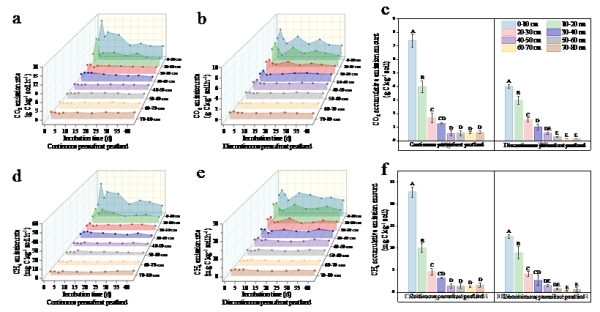
Figure 1. Soil CO2 and CH4 emission rates through the peatland profile from different types of permafrost region.
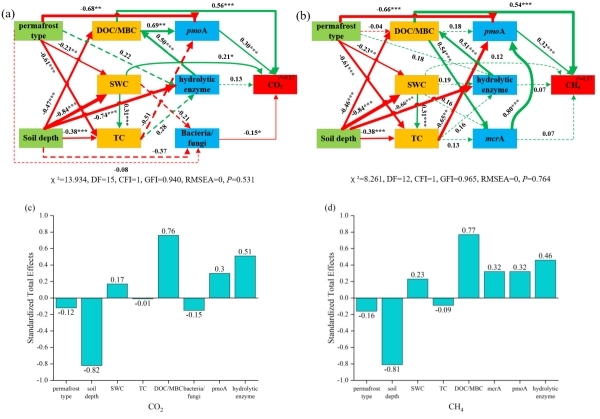
Figure 2. Permafrost type, soil depth, and biochemical factors affecting the CO2 and CH4 emission rates from continuous and discontinuous permafrost peatlands based on structural equation modeling.
Keywords:
Permafrost peatland, Bacteria, Fungi, Soil enzyme, Greenhouse gas, RubisCO
Contact:
SONG Yanyu
Northeast Institute of Geography and Agroecology, Chinese Academy of Sciences
E-mail: songyanyu@iga.ac.cn
Attachment:
Vertical profiles of soil CO2 and CH4 emissions and their driving mechanisms in different types of permafrost peatlands
https://doi.org/10.1016/j.jhydrol.2025.134754


