Greenhouse gases (GHG) like carbon dioxide (CO2), methane (CH4), and nitrous oxide (N2O) emissions are affected by nitrogen (N) inputs and climate warming, yet their combined impacts on wetland GHG dynamics remain elusive.
Recently, a research team led by Prof. Yanyu Song from the Northeast Institute of Geography and Agroecology, CAS investigated the response mechanism of soil CO2, CH4, and N2O emissions from the Sanjiang Plain wetlands in northeastern China to interactive N input and warming.
This work was published in the journal of Applied Soil Ecology on March, 2026.
The researchers found that short-term N input and warming significantly boosted CO2 and N2O emissions. High N input suppressed CO2 release by disrupting the competitive balance among microorganisms and causing soil nutrient imbalance. N input strongly inhibited CH4 emissions, with greater suppression at higher levels. N input had a stronger effect on CH4 and N2O, while warming influenced CO2 more. Mantel and linear regression analyses revealed that CO2 and N2O emissions were positively correlated with microbial biomass carbon (MBC) and microbial biomass nitrogen (MBN) contents. CO2 and CH4 emissions were also influenced by enzymes and bacterial activities, while CH4 emissions were positively regulated by the mcrA: pmoA gene abundance ratio and negatively affected by nitrate nitrogen (NO3--N) content. Ammonium nitrogen (NH4+-N) and denitrification genes primarily drove N2O emissions.
This study provides valuable insights into the microbial mechanisms regulating GHG emissions under N enrichment and warming, offering a scientific foundation for optimizing carbon and nitrogen management strategies in wetland ecosystems in the context of global climate change.
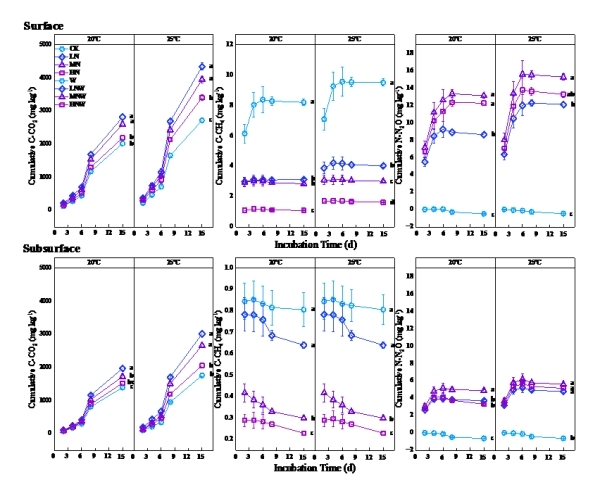
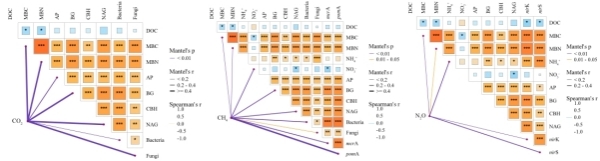
Figure 1 Driving mechanism of CO2, CH4 and N2O emissions from wetland soils under nitrogen input and warming
Keywords:
Wetland; Greenhouse gas; Soil microorganism; Denitrification; Denitrifying anaerobic methane oxidation
Contact:
Song Yanyu
Northeast Institute of Geography and Agroecology, Chinese Academy of Sciences
E-mail: songyanyu@iga.ac.cn
Attachment:
Responses of greenhouse gases emissions from wetland soils to the interactive effects of nitrogen input and warming in Sanjiang Plain, China
https://doi.org/10.1016/j.apsoil.2026.106923


